

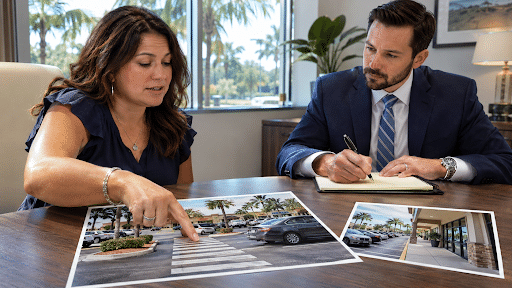
Walking between a parked vehicle and a building can involve drive aisles, entrances, sidewalks, and several changes of direction. When an incident occurs along that route, a general address may leave much of the setting unexplained. Kevin L. Sullivan II lists pedestrian accidents among the practice areas on his Zephyrhills personal injury page.
That listing gives people researching a pedestrian incident a relevant place to begin. For an inquiry involving a parking area, a clear description of the surroundings can help communicate what the person remembers without requiring them to interpret legal responsibility.
Describing the Place Within the Address
A shopping center or other property may have several entrances and parking sections. Someone describing an incident can identify nearby features such as a storefront, an entrance sign, a sidewalk connection, or a particular row of parking spaces.
A simple sketch may help explain those relationships. It can show the person’s remembered walking route and the location of nearby vehicles, while labeling any uncertain positions. The purpose is to make the account easier to understand.
A sketch drawn later should remain distinguishable from a photograph taken at the time. Each provides a different kind of information about the person’s recollection and the setting.
Connecting the Inquiry to a Listed Practice Area
The Zephyrhills practice-area page for Kevin L. Sullivan II includes pedestrian accident matters. For someone comparing legal services, that published category is relevant to a question involving a person traveling on foot.
The details still matter. A person can describe whether they were approaching a building, returning to a vehicle, or walking between parts of a property. Those descriptions explain the activity without presuming how the incident should be resolved.
Distinguishing Observations From Later Information
Parking areas can be busy, and a person may only see part of an event. An account can separate directly observed details from information supplied afterward by another person.
For example, the person may remember their direction of travel but be unsure where a vehicle began moving. Preserving that distinction keeps the account accurate to their experience. An unanswered question can remain an unanswered question.
Existing photographs can also be described by when they were taken and what they show. An image of the area on a later date should be identified accordingly.
Preparing a Focused Conversation
Kevin L. Sullivan II’s Zephyrhills page offers a free, no-obligation consultation. A person considering an inquiry can ask whether the matter fits the practice and what details would be useful to discuss.
A short description of the walking route, the immediate surroundings, and the sequence remembered by the person can provide a practical starting point. Keeping those elements separate makes it easier to explain a parking-area incident without compressing it into an incomplete label.